
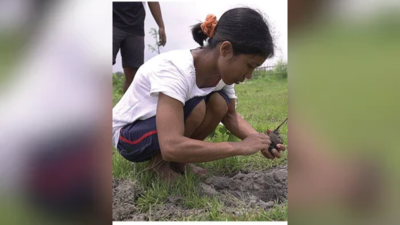
Jadav Payeng did not begin with a grand plan to build a forest. In 1979, when he was just 16, he was deeply affected by the sight of snakes dying on a barren sandbar along the Brahmaputra River in Assam. He began planting trees, and what started as a young boy’s response to a disturbing sight became a lifelong commitment. Today, his daughter, Munmuni Payeng, is carrying that commitment forward, working with local communities to restore degraded river islands and create new habitats for wildlife.
The forest that began with one young man’s determination
Known as the ‘Forest Man of India’, Jadav Payeng spent decades planting and nurturing trees on land that was vulnerable to flooding and erosion. His efforts helped create Molai Forest, a roughly 550-hectare stretch of woodland near Jorhat in Assam.The forest is now home to diverse plant and animal life, including birds, deer and other wildlife. Elephants also visit the area. Payeng received the Padma Shri in 2015 for his contribution to environmental conservation.Yet his story is not simply about the number of trees he planted. It is about the years of work required to help a landscape recover. Planting a sapling is only the beginning. Keeping it alive through floods, changing soil conditions and other natural challenges demands patience and continued care.
Meet Munmuni Payeng, who wants to grow a million native trees
Munmuni has chosen to take her father’s work beyond the existing forest. According to the Sanctuary Nature Foundation, she has been working with local communities on a project to grow one million native trees on sandbars near Molai Forest.The aim is to restore green cover in areas where erosion and flooding threaten fragile habitats. The project focuses on native species suited to the local environment, with the wider goal of giving displaced wildlife more space to survive.“There were no trees when we started. Now, slowly, the land is changing,” Munmuni told The New Indian Express.
Her mission goes beyond planting saplings
Munmuni’s work also involves bringing people into conservation. She has led grassroots efforts with volunteers and local residents, while organising nature-awareness activities for children and communities.She serves as secretary of the Forest Man Foundation and has been associated with Seuj Dhoroni, a grassroots nature-conservation initiative. Her work reflects an important lesson: a forest cannot be protected by one person alone. Local communities must have a role in caring for the land around them.That approach also gives the project a social dimension. Conservation becomes more sustainable when residents understand why the land matters and take part in protecting it.
A difficult reminder that forests remain vulnerable
The family’s work has faced setbacks. In December 2025, a fire damaged part of the Molai Kathoni 2.0 plantation, the reforestation project led by Munmuni. Reports said more than 5,500 saplings were destroyed. Authorities began investigating the incident, while the team worked to limit the damage.The incident highlighted a reality that celebratory stories about tree planting can overlook. Years of work can be threatened by a single event, and newly planted saplings remain especially vulnerable.
Carrying a legacy without repeating the same story
Jadav Payeng’s achievement was to show what sustained individual effort can do. Munmuni’s challenge is different: she is working to extend that effort across vulnerable areas, involve more people and help new forests take root.Her mission is not merely to preserve her father’s name. It is to create places where trees can grow, wildlife can find shelter and local communities can take part in protecting their environment.The real measure of this legacy will not be the number of saplings planted on a particular day. It will be how many survive, grow into trees and help the landscape endure.Disclaimer: This article draws on reporting by The New Indian Express, the Sanctuary Nature Foundation and India Today on Jadav Payeng, Munmuni Payeng and their conservation work. Project targets and reported damage reflect published accounts; planting outcomes may change over time.