
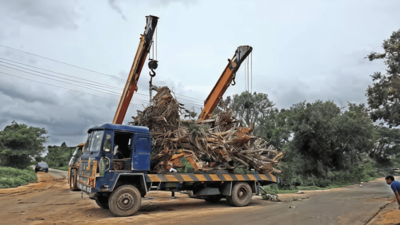
When a link road threatened around 800 mango trees on a 150-acre residential project in Hyderabad, developer Ashwin Rao faced a difficult choice: allow the trees to be cut or find a way to preserve them. He chose the latter, bought another plot of land and arranged to move the trees. The process took six to eight months.As reported by The Indian Express, Rao’s decision was influenced by an earlier experience in 2015, when a nearly 100-year-old banyan tree in Zaheerabad faced removal. With help from the Vata Foundation, an organisation that works to protect and relocate trees, he moved the tree to vacant land he owned. That experience taught him that relocating a mature tree involves more than digging it out and planting it elsewhere. Its roots, orientation and growing conditions must also be considered.
Why moving mature trees is not as simple as planting saplings
When development projects require trees to be removed, compensatory plantation is often used to offset the loss. But planting new saplings does not immediately replace the benefits of mature trees, which have spent years growing and storing carbon. As reported by The Indian Express, tree translocation, uprooting a tree and replanting it at another location is one alternative when preserving a tree in its original place is not possible. However, the process is technically demanding, and survival is not guaranteed.The Vata Foundation, which assisted Rao with the banyan tree, has been involved in relocating mature trees since 2015. According to the foundation’s official website, its work includes identifying trees threatened by development, finding suitable locations and helping arrange their relocation.The organisation’s work highlights why preparation matters. Trees must be handled carefully during uprooting and transport, and they need appropriate conditions and continued care after being replanted. Rao’s experience with the banyan tree also highlighted the importance of timing. The 2015 relocation was carried out during the monsoon, when, he said, the “chances of survival of translocated trees are the highest”. The same principle informed the later effort to move the mango trees.
How the foundation helps trees find new homes
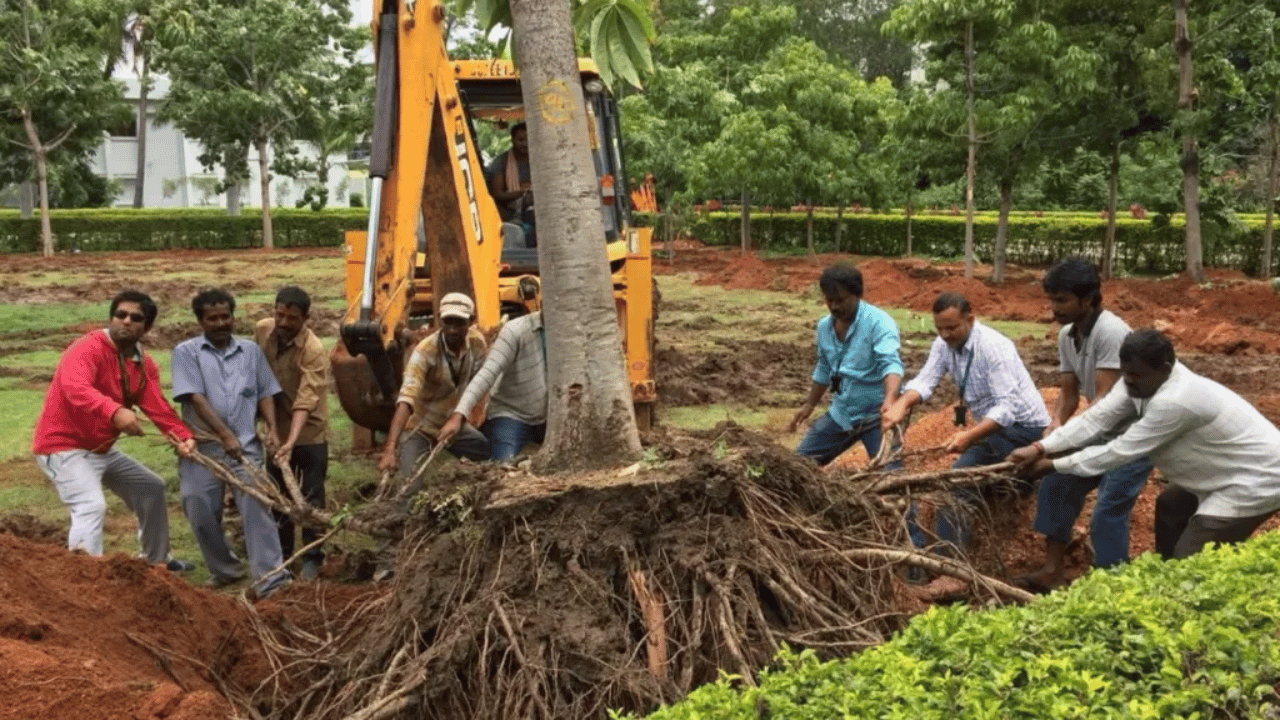
Photo credit: Vata Foundation
Vata Foundation founder Uday Krishna began exploring alternatives to tree felling after a construction project in Hyderabad in 2010 required 45 trees to be cut. During a later foot-overbridge project, he arranged to move 16 trees instead. Thirteen survived. That experience also exposed a gap in how compensatory planting was monitored. Krishna observed that after permission was granted to remove trees for development, there was often little follow-up on whether replacement saplings survived.The foundation subsequently developed a tree-adoption model. Some adopters provide both land and funds, while others offer land where trees can be replanted. According to Krishna, the foundation has helped more than 17,500 trees find new homes since 2015, drawing on a network of around 8,000 people across the country.The foundation’s work also shows why moving mature trees cannot be treated as a guaranteed solution. In 2018, volunteers found two banyan trees, each more than 100 years old, that had been uprooted and left beside a road. A school in Hyderabad agreed to adopt them, and a fourth-grade girl in the United States raised around Rs 95,000 towards the relocation.The operation faced several problems. The equipment was inadequate, the truck transporting the trees broke down, and the trees were moved around 10 days after they had been uprooted. Only one survived.Another rescue had a different outcome. In 2017, a Jungle Jalebi tree at Government Girls High School in Nagarkurnool fell during a storm but continued bearing fruit. The school’s former principal, Yashodha, resisted its removal for almost two-and-a-half months. After learning about the tree, Krishna offered to help. On July 28, 2017, his team used a single JCB to set it upright again. The schoolgirls have since held a festival for the tree every year on that date.
Why conservationists say relocation should be the last resort
Tree translocation has also been considered for larger infrastructure projects. Vata Foundation partnered with the Indian Navy on a project involving thousands of mature trees in the Damagundam Reserve Forest in Telangana, where a Very Low Frequency radar communication station is planned. The project involves diversion of forest land and tree felling.The wider challenge is not simply how many trees are planted or moved, but whether they survive and continue to provide ecological benefits. The Vata Foundation’s work reflects the importance of finding suitable sites and arranging care after relocation, rather than treating the act of planting as the end of the process.